MASHBOOH
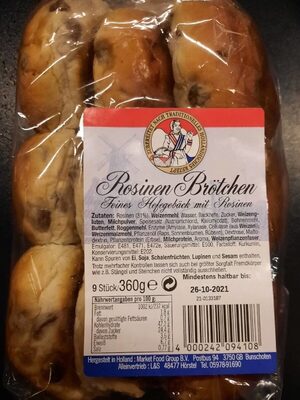
Rosinenbrötchen
Krakend Vers B.V.
Barcode
4000242094108
Category
Pflanzliche Lebensmittel und Getränke, Pflanzliche Lebensmittel, Imbiss, Getreide und Kartoffeln, Süßer Snack, en:Sweet pastries and pies, Brote, Viennoiseries, Brötchen, Rosinenbrote
Manufactured In
-
Ingredients
rosinen
_weizenmehl_
wasser
backhefe
zucker
_weizengluten_
_milchpulver_
speisesalz
natriumchlorid
kaliumjodat
bohnenmehl
_butterfett_
_roggenmhel_
enzyme
amylase
xylanase
cellulase
aus _weizen_
_weizenmalzmehl_
pflanzenöl
raps
sonnenblumen
rübsen
dextrose
maltodextrin
pflanzenprotein
erbse
_milchprotein_
aroma
_weizenpflanzenfaser_
emulgator
e481
e471
e472e
säuerungsmittel
e500
farbstoff
kurkumin
konservierungsmittel
e202
Status: UNKNOWN
Status: UNKNOWN
Status: HALAL
Reason: Water is a natural substance that is free from impurities and holds no religious prohibition.
Uses: Used for drinking, cooking, and various other applications.
Status: UNKNOWN
Status: HALAL
Reason: Plant-derived sugar, permissible in halal diets.
Uses: sweetening, flavor enhancement
Status: UNKNOWN
Status: UNKNOWN
Status: HALAL
Reason: Common table salt, no animal origin.
Status: UNKNOWN
Status: UNKNOWN
Status: UNKNOWN
Status: UNKNOWN
Status: UNKNOWN
Status: MASHBOOH
Reason: Enzymes can be derived from both halal and haram sources. Without specific identification of the source, the status remains unclear.
Uses: Enzymes are commonly used in food processing, fermentation, and as digestive aids.
Status: MASHBOOH
Reason: Amylase can be derived from both plant and animal sources, but the specific source is not always clear.
Uses: Amylase is used in the food industry to break down starches into sugars, and is commonly found in baked goods and brewing.
Status: UNKNOWN
Reason: Enzyme used in food processing, origin unclear.
Status: HALAL
Reason: Enzyme used in food processing
Uses: food processing, digestive aid
Status: UNKNOWN
Status: UNKNOWN
Status: UNKNOWN
Status: UNKNOWN
Status: UNKNOWN
Status: UNKNOWN
Status: HALAL
Reason: Glucose sugar, derived from plants.
Uses: sweetener, food additive
Status: HALAL
Reason: Derived from starch, widely used as a thickener.
Uses: thickening, bulking agent in foods
Status: UNKNOWN
Status: UNKNOWN
Status: UNKNOWN
Status: HALAL
Reason: Synthetic or natural flavoring, no animal origin.
Uses: flavoring in food products
Status: UNKNOWN
Status: MASHBOOH
Reason: Emulgators can be derived from both halal and haram sources. Without specific information on the source, it remains uncertain.
Uses: Emulgators are commonly used in food products to stabilize mixtures such as oil and water, and are found in items like dressings, sauces, and baked goods.
Status: MASHBOOH
Reason: E481 refers to mono- and diglycerides of fatty acids, which can be derived from both animal and vegetable sources, making its halal status uncertain without further information.
Status: MASHBOOH
Reason: E471, also known as mono- and diglycerides, can be derived from both plant and animal sources, making its status uncertain without specific source information.
Uses: Used as an emulsifier in food products.
Status: HALAL
Reason: Derived from vegetable sources and generally considered halal.
Uses: Emulsifier, stabilizer, thickener
Status: UNKNOWN
Status: HALAL
Reason: Mineral salt, common food additive.
Uses: acidity regulator, stabilizer
Status: MASHBOOH
Reason: Generic term for colorants; requires specification.
Uses: coloring food products
Status: UNKNOWN
Status: UNKNOWN
Status: MASHBOOH
Reason: E202 is a preservative (sorbic acid) which can be derived from both animal and plant sources, making its halal status uncertain without specific sourcing information.
Nutrition Facts
Energy per 100 g / 100 ml
237 kcal
Energy per 100 g / 100 ml
1002 kJ
Fat per 100 g / 100 ml
1.8 g
Saturated fat per 100 g / 100 ml
0.7 g
Carbohydrates per 100 g / 100 ml
47.2 g
Sugars per 100 g / 100 ml
24.4 g
Fibre per 100 g / 100 ml
3.6 g
Protein per 100 g / 100 ml
6.7 g
Salt per 100 g / 100 ml
0.77 g
Sodium per 100 g / 100 ml
0.308 g


