MASHBOOH
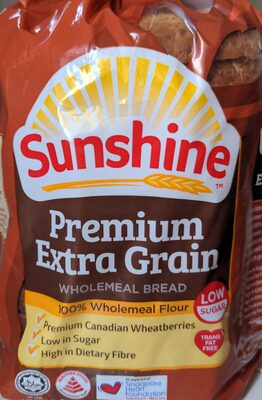
Premium Extra Grain Wholemeal Bread
Sunshine
Barcode
8888010101809
Category
Plant-based foods and beverages, Plant-based foods, Cereals and potatoes, Breads, Sliced breads, Wholemeal breads, Wholemeal sliced breads
Manufactured In
-
Ingredients
wholemeal flour
wheat
water
_wheat_ gluten
sugar
vegetable shortening (palm). sorbitol
salt
oat fibre
yeast
(amylase, hemicellulase, lipase)
calcium propionate
calcium (calcium sulphate, calcium carbonate)
wheat starch
ferric phosphate
silicon dioxide
ascorbic acid
vitamin b3 (niacin). vitamin b1 (thiamine)
folic acid
Status: HALAL
Reason: Wholemeal flour is made from whole grains and does not contain any haram substances.
Uses: Used in baking bread, pastries, and for thickening sauces.
Status: HALAL
Reason: Wheat is a plant-based ingredient and does not contain any haram components.
Uses: Wheat is commonly used in baking, cooking, and as a base for many food products such as bread, pasta, and noodles.
Status: HALAL
Reason: Water is a natural substance without any impurities or prohibited components.
Uses: Used for drinking, cooking, cleaning, and various other purposes.
Status: HALAL
Reason: Wheat gluten is derived from wheat and does not contain any haram substances.
Uses: Commonly used in baking and as a protein source in vegetarian and vegan food.
Status: HALAL
Reason: Sugar is derived from sugarcane or sugar beets and does not contain any haram ingredients.
Uses: Sugar is used as a sweetener in a variety of food and beverage products.
Status: MASHBOOH
Reason: The ingredient may contain additives or processing agents that are not clearly halal or haram.
Uses: Used as a fat substitute in baking and frying, and as a stabilizer in various food products.
Status: HALAL
Reason: Salt is a mineral primarily composed of sodium chloride and does not contain any haram components.
Uses: Used as a seasoning and preservative in food.
Status: HALAL
Reason: Oat fibre is derived from oats, which are a plant-based source. It does not contain any haram ingredients.
Uses: Oat fibre is commonly used as a dietary fiber supplement, in baking, and as a thickening agent in various food products.
Status: HALAL
Reason: Yeast is a type of fungus used in baking and fermentation, and is generally considered halal.
Uses: Used in baking bread, brewing beer, and in fermentation processes.
Status: MASHBOOH
Reason: These are enzymes that can be derived from both plant and animal sources, making their halal status uncertain without specific sourcing information.
Uses: Used in food processing, baking, and fermentation to break down carbohydrates, fibers, and fats.
Status: HALAL
Reason: Calcium propionate is a food additive used as a preservative and is derived from calcium and propionic acid, both of which are halal.
Uses: Commonly used in baked goods to prevent mold growth and extend shelf life.
Status: HALAL
Reason: Calcium is a mineral that can be derived from various sources, including non-animal sources.
Uses: Commonly used as a dietary supplement and in food fortification.
Status: HALAL
Reason: Wheat starch is derived from wheat, which is a plant-based source and does not contain any harmful or haram substances.
Uses: Used as a thickening agent in food products, sauces, and baked goods.
Status: HALAL
Reason: Ferric Phosphate is a mineral compound and does not derive from animal sources or contain harmful substances, making it permissible.
Uses: Commonly used as a food additive, nutrient source in fertilizers, and as a colorant.
Status: HALAL
Reason: Silicon Dioxide is a naturally occurring mineral and does not contain any animal products or substances derived from Haram sources.
Uses: Commonly used as an anti-caking agent in food products, as well as in pharmaceuticals and cosmetics.
Status: HALAL
Reason: Ascorbic acid is a naturally occurring compound and is generally derived from fruits and vegetables.
Uses: Used as an antioxidant and food preservative, as well as in dietary supplements.
Status: HALAL
Reason: Vitamin B1, also known as thiamine, is typically derived from sources that are halal, such as grains and legumes.
Uses: Vitamin B1 is used as a dietary supplement and is crucial for energy metabolism in the body.
Status: HALAL
Reason: Folic acid is a synthetic form of vitamin B9, commonly used in dietary supplements and fortified foods, and does not have any non-halal sources.
Uses: Used to prevent folate deficiency, in prenatal vitamins, and to support overall health.
Nutrition Facts
calcium
0.309
calcium_100g
0.309
calcium_unit
mg
calcium_value
309
carbohydrates
35.7
carbohydrates_100g
35.7